The Frost Archive
The sub-crypts beneath the Stephansdom were a place of absolute zero.
The air scratched the lungs like ground glass. It was so old it had forgotten how to be breathable. Herr Grüber moved through the lowest level with the precise, bureaucratic gait of a man who had filed bones for twenty-three years. He carried his thermos of lukewarm chicory like a holy relic, a small, pathetic rebellion against the cold that permeated everything down here.
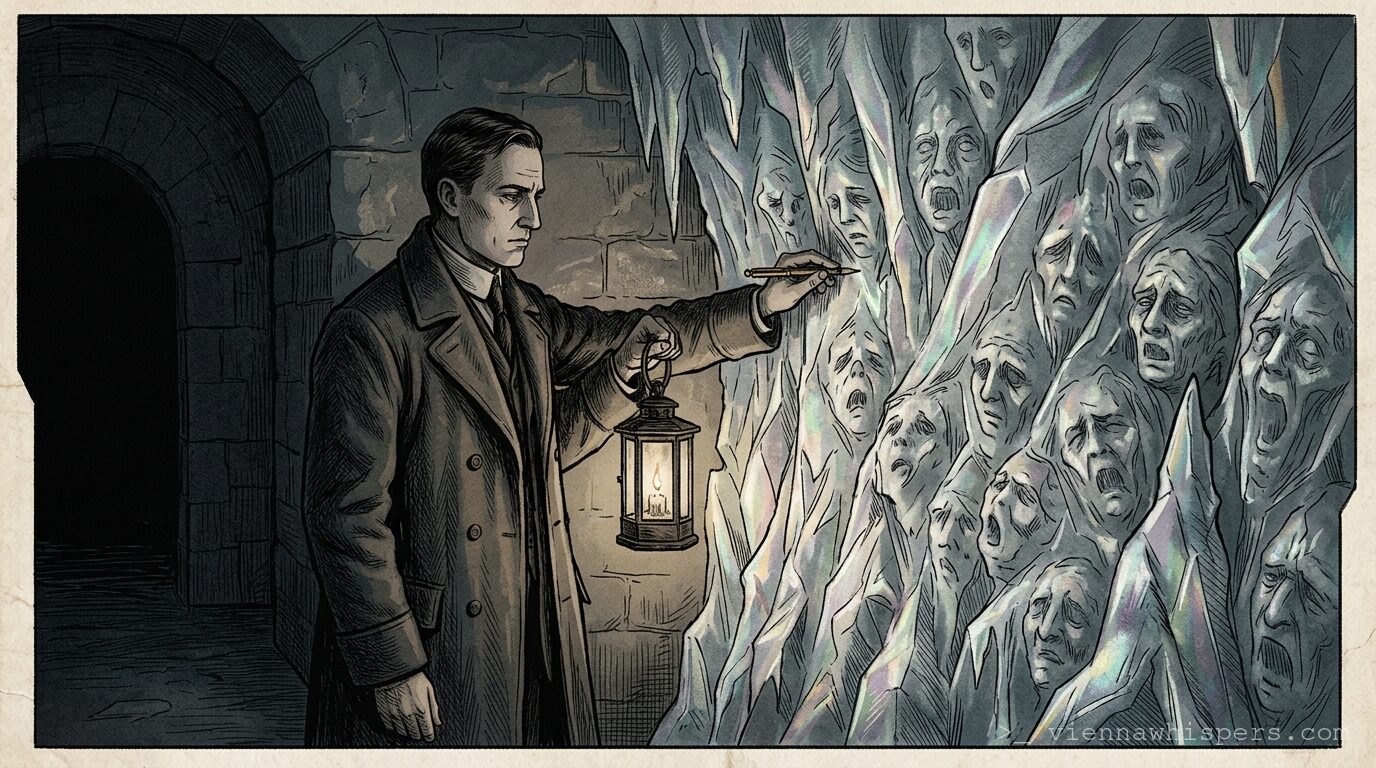
The frost did not behave like ice. It was a crystalline growth, serrated and iridescent, clinging to the damp walls where the 1679 plague pits met the older Roman foundations. It was coldest where the faces were — thousands of them, or perhaps only one face repeated through the distorting lens of frozen condensation, pressed into the stone like delicate, intricate fossils shaped by the final, frantic expulsions of breath.
Grüber stopped before a particularly dense bloom in Sector 4-B. He leaned in until his nose was inches from the jagged, needle-like shards. The temperature dropped sharply. His breath fogged, then froze mid-air in tiny, suspended crystals.
The sound began as a faint, sub-sonic clicking — the crystalline lattice expanding under the slight shift in pressure caused by his body heat.
He did not move. He rarely did anymore. His job was not to disturb, but to document. The rash behind his left ear had begun to bleed again, a thin, warm line trickling down his neck and soaking into the collar of his shirt. He did not wipe it away. The pain was familiar. It helped him stay focused.
The frost bloomed in perfect, mathematical patterns across the porous limestone. It was not decoration. It was an archive — a slow, crystalline preservation of everything the city above preferred to forget.
Grüber adjusted his spectacles. His fingers were steady, mechanical. The air tasted of wet stone, ancient rot, and the faint metallic tang of preserved despair.
Nothing moved.
The cathedral above continued its noisy, self-important performance, unaware that beneath its foundations something ancient and indifferent was keeping perfect, frozen count.
The temperature rose by a fraction of a degree.
It was almost nothing — a microscopic shift caused by the ventilation shafts or the slow, inevitable decay of the cold itself. But it was enough.
The frost began to weep.
The crystalline structures, so sharp and iridescent only minutes before, softened at the edges. Water beaded on the surface like sweat on cold skin. The voices, previously preserved in icy encryption, lost their brittle clarity and became wet, hectic, overlapping.
“…dass die Ratten nicht singen, nur die Stille…”
The woman from 1679. Her voice was no longer dehydrated. It was raw, urgent, dripping.
“…ich habe meinen Schlüssel im Brot versteckt, mein Gott, mein Gott, niemand wird ihn finden…”
Another fragment, a mother during the plague. The words slurred together as the ice melted, turning into a frantic, wet stuttering that echoed through the chamber like multiple people speaking at once through the same broken mouth.
Herr Grüber stood motionless, his lantern trembling in his hand. The rash behind his left ear began to bleed again, a thin, warm line trickling down his neck. He did not wipe it away. For the first time in twenty-three years of cataloguing these depths, he felt an uncharacteristic urge — sharp, almost violent — to press his own face against the wet stone and add his voice to the archive. To scream his own boring, petty misery into the frost before it could claim him too.
He resisted.
The meltwater ran faster now, carving tiny channels through the porous limestone. The city was absorbing its own history again, pulling the plague voices back into its foundations like a sponge soaking up spilled ink. The memories were disappearing, not with drama, but with the quiet, bureaucratic efficiency of Vienna sealing its own records.
Grüber closed his ledger with a soft, final snap. He checked his watch. Six hours and twelve minutes. The bells of the Stephansdom began to ring above — loud, clanging, self-important — sending a vibration through the ceiling that caused a small cascade of fine lime-dust to fall like gray snow.
He turned toward the spiral staircase. His boots clicked in perfect, mechanical time against the stone. He left the door to the catacombs slightly ajar — a small, unnecessary error in an otherwise orderly day.
Behind him, the last fragments of the voices dissolved into the walls with a wet, fading hiss.
The frost archive was closing for the night.
Support us
Vienna Whispers is free to read. If you enjoy the stories, we’d be grateful for your support.