The Spinner Who Never Finished
The Triester Straße is not a place for waiting. It is an artery designed strictly for departure and arrival, a relentless four-lane corridor of asphalt, exhaust, and aggressive commuting that bleeds southern Vienna into the surrounding valleys. Cars idle in the smog. Trucks brake with the sound of grinding molars. It is loud, ugly, and entirely functional.
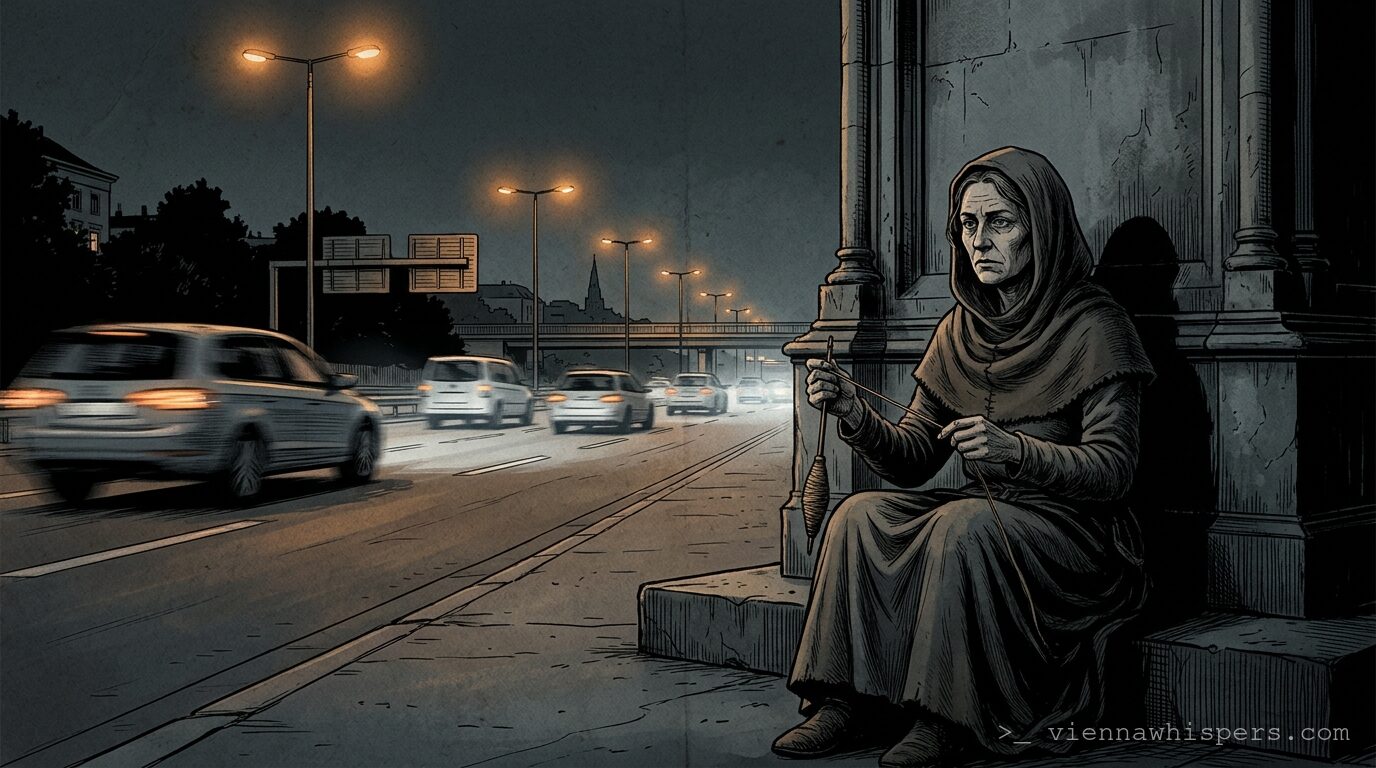
Trapped on a small traffic island amidst this daily hostility stands a jagged gothic pinnacle of limestone, black with age and diesel soot. Die Spinnerin am Kreuz. The Spinner at the Cross. Tourists rarely come here. The locals do not look at it. To the Viennese, a monument is only visible during its unveiling; after a week, it becomes infrastructure, and after a century, it becomes an obstacle.
But she is still sitting at the base of it.
She is not a ghost. Ghosts are born of sudden trauma, of things violently interrupted. She is something heavier: a continuation. She is the sheer, compounding weight of an unresolved afternoon in the late twelfth century.
Her fingers are stained with the lanolin of eight hundred years of raw sheep’s wool, the grease rubbed deep into the whorls of her skin. The wooden spindle rests against her thigh, worn perfectly smooth by friction and time. She draws the raw fleece from the woven willow basket at her feet, twisting it, pulling it, feeding it to the drop-spindle. Whir, drop, catch. Whir, drop, catch.
She came to this hill, the Wienerberg, to watch the southern road. Her lover had taken the cross, marching behind the banners of Duke Leopold to take back the Holy Land. He promised to return along this exact route. He told her to wait.
In 1194, a returning merchant with a missing eye and a terrible cough stopped on the hill and told her that her lover had died of dysentery outside the walls of Acre, screaming for water in a language no one around him spoke. She had called the merchant a liar, picked up her spindle, and kept watching the road.
Grief is a finite resource; eventually, it becomes merely an administrative habit. She continues to spin not out of hope, but because waiting is the physical architecture of a grudge. To stop spinning would be to admit the merchant was right, and she dislikes being corrected.
And so, she watches. The hill was open country once, a high ridge looking down on the walled jewel of the city. Because it was high and visible, the city administration, possessing the eternal Viennese flair for theatrical pessimism, decided it was the perfect place for the gallows.
For centuries, she shared her waiting room with the doomed. She watched the executioners drag carts up the muddy incline. She listened to the creak of the hanging ropes and the wet, heavy thuds of the breaking wheel. The executions were intended to be solemn warnings to the populace, but the Viennese treated them as Sunday picnics, arriving with sausages, sweet wine, and highly critical opinions of the hangman’s technique.
She found the dying mostly tedious. Men face death with remarkably poor posture, and almost always complain about the weather before the drop. In 1720, a prolific counterfeiter of imperial florins slipped a silver coin to his executioner to ensure a swift breaking of the neck, and then spent his final three minutes on earth loudly demanding a written receipt for his own bribe. He went to his maker outraged by the lack of paperwork. The crowd found it hilarious. She merely sighed, adjusting the tension on her thread. The dead swung in the wind above her, casting long, swinging shadows across her wool, ticking like metronomes keeping time for her spindle.
Empires swept past her, rising in gold and rotting in the mud. She watched the Ottoman tents pitch themselves across the fields in 1529, smelling of dark coffee, roasted mutton, and damp canvas. She watched them retreat. She watched them return a century later, dying in the same mud. Napoleon’s troops marched past, chipping souvenirs off her stone cross with their bayonets, speaking a fast, nervous language.
The Habsburgs unraveled before her eyes. The uniforms of the armies marching south changed colors like dying leaves. She saw the bright imperial white turn to cornflower blue, the blue fade to pike-grey, the grey rot into the field-green of the dying monarchy.
Every fallen empire leaves behind a specific kind of dust. The Austro-Hungarian collapse felt like moth eaten velvet turning to powder. The double-headed eagle did not fly away; it molted, feather by feather, into the gutters of the Favoriten district. A cavalryman rode past her in the autumn of 1914, his brass buttons gleaming, his posture rigid with honor, completely unaware that he and his entire century were already ghosts. In 1918, he walked back up the same hill, minus his left arm, wearing a torn coat that smelled of wet dog and iodine. He sat on the base of her cross and wept. She did not comfort him. Crying ruins the tension of the wool.
Her thread grew. Over the centuries, it spilled from her spindle, winding down the hill. It is invisible to the living, but it is there. It weaves through the foundations of the Karl-Marx-Hof. It tangles in the roots of the chestnut trees in the Prater. It wraps tightly around the pale, dead neon tubes of an abandoned gas station on the edge of the city. She has spun enough yarn to knit a shroud for the entire continent, but she has never cast on the first stitch. The thread just keeps running, sinking into the soil, forming the mycelium of Vienna’s specific, incurable melancholy.
Today, the twilight settles over the Triester Straße. The Blue Hour. The sky bruises into a deep, clinical indigo, and the streetlights flicker on in staggered, hesitant relays.
The gallows are gone. The fields are gone. Now, there is only the roar of the B17 highway, the rattling approach of the 15A bus, and the harsh, stuttering glow of a digital billboard advertising cheap flights to Antalya.
A young couple stands near the edge of her traffic island, waiting for the pedestrian light to change. They are not looking at each other. The young man is staring at a crack in his phone screen; the young woman is aggressively peeling the label off a plastic water bottle. The air between them is thick with things they have decided not to say, a modern, silent siege. They do not look at the gothic spire. They do not see the woman sitting at its base.
She watches them with mild, structural contempt. The city has forgotten how to wait properly. They wait for buses, they wait for texts, they wait for the weekend, but they have lost the endurance for deep, geological waiting. They do not know how to turn their waiting into an object.
She reaches down into the willow basket to draw the next handful of fleece.
Her fingers brush the bottom.
She pauses. The rhythm of eight hundred years skips a beat. Whir, drop— nothing.
She looks down. The basket, which has replenished itself in the dark since the reign of the Babenbergs, is empty. There is only the smooth, woven wood, polished by centuries of lanolin. A single, small tuft of grey wool remains, no larger than a plum.
The raw material of the Middle Ages has finally run out.
She holds the last tuft in her blackened hands. It smells of woodsmoke, plague-fire, and wet earth. If she spins this last piece, the thread will end. If the thread ends, the act of waiting is over. And if the waiting is over, she will finally have to stand up, turn around, and admit to the empty road that nobody is coming.
She places the fleece against the spindle. She begins to twist. The spindle drops. The wool stretches, thinning out, becoming a taut line. She watches the end of it approach her fingertips. Four inches left. Three. Two.
A gust of wind sweeps off the asphalt, carrying the sour smell of wet garbage and diesel. It blows a piece of modern detritus against the base of her limestone cross—a long, frayed strip of bright blue synthetic nylon, torn from a cheap promotional umbrella. It snags on the rough stone, fluttering violently in the drafts of passing cars.
She looks at the empty end of her medieval thread. She looks at the blue plastic nylon.
Logic dictates the end. Dignity dictates a clean finish.
She reaches out, catches the piece of torn blue nylon, and presses it tightly against the last microscopic fibers of her holy wool. She rolls them together between her thumb and forefinger, forcing the cheap, chemical plastic to bind with the grease of the crusades. She believes, with the absolute conviction of the truly stubborn, that this makes sense.
She gives the spindle a hard twist.
The nylon catches. The spindle drops. The rotation pulls the thread taut, but the plastic has no memory, no texture to hold the twist. It slips against the wool.
The thread snaps with a sound like a breaking violin string.
The spindle falls, hits the concrete paving stones, and rolls lazily into the gutter, coming to rest against a discarded cigarette box.
The traffic light turns green. The young couple steps off the curb and crosses the street, walking slightly apart.
Support us
Vienna Whispers is free to read. If you enjoy the stories, we’d be grateful for your support.