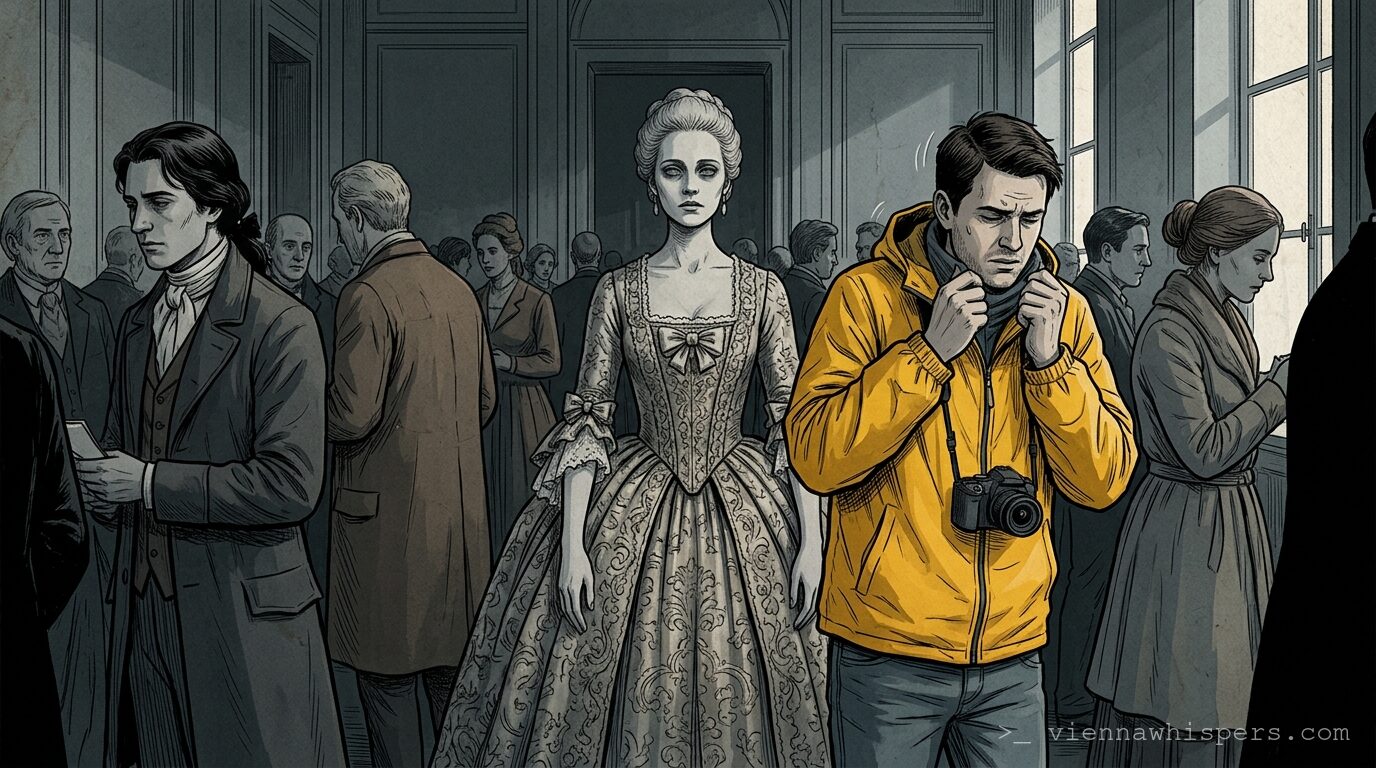
The White Lady of Schönbrunn
The cleaning staff arrives at six in the morning, smelling of cheap filter coffee and damp polyester. I wait for them in the Hall of Ceremonies, standing quietly beside the great porcelain stove. They drag their industrial buffers across the intricate parquet, filling the room with the scent of synthetic lemon and the low, mechanical hum of the twenty-first century.
I do not move out of their way. They move through me. It feels like a sudden draft passing through the ribcage, a brief intrusion of body heat and hurried heartbeats.
I still wear the dress in which I died. The heavy, pale brocade drags silently across the polished floors, burdened with two hundred and fifty years of accumulated, invisible dust. The corset still presses against ribs that no longer exist. It is a beautiful gown, entirely unsuited for eternity.
By nine o’clock, the doors unlock. The daily invasion begins.
They pour through the enfilade in rivers of Gore-Tex, denim, and sensible walking shoes. They wear blinking audio guides around their necks like amulets, pressing buttons to hear a sanitized, heavily edited version of my family’s misery. The narrators speak of grand balls and imperial treaties; they tactfully omit the screaming in the delivery rooms, the syphilis, the terrible, heavy silences at the dinner table.
I watch them. I am a spectator to my own afterlife. They lift their glowing, rectangular screens, photographing the red damask walls, the gold leaf, the empty beds. They smile into the mirrors that once reflected the sweat of dying archdukes.
I am looking for something.
A child, I think. Or a promise that was broken in the dark paneled room just off the Great Gallery. Perhaps both. To be perfectly honest, the specific gravity of the grief has faded, leaving only its outline. My memory is a moth-eaten tapestry. I remember the heavy weight of a man’s gold signet ring pressing into my collarbone, but I do not remember his face. I remember the smell of rain on a wool riding coat, but not the horse. I remember the frantic, tearing pain of the loss, but the name of the child slips off my tongue like water over polished marble.
If I actually found what I am looking for, I wouldn’t know what to do with it. Eternity makes one an exceptionally unfit mother. But I keep searching because the search is the only thing that gives me a shape.
Around two in the afternoon, the crowd peaks. A heavy-set man in a bright yellow windbreaker stops directly in front of me to adjust the settings on his camera. He steps backward, passing his left shoulder entirely through my sternum.
A sudden, sharp drop in the barometric pressure of his personal space makes him freeze. He shivers, violently. He rubs his arms, looks up at the painted ceiling, and frowns.
“Damn drafts,” he mutters to his wife. “These old Austrian buildings. Impossible to heat.”
They always blame the building. They blame the mortar, the altitude, the single-pane glass. They never blame their own creeping mortality, which is what I actually feel like.
I do not haunt. Haunting implies a desire to frighten, a petty, theatrical need for attention. I lack the energy for spite. I simply remain.
Sometimes, though, I am seen. The adults are blind, their vision completely occupied by their schedules and their screens, but the children are different. They have not yet learned to filter out the impossible.
In the Millions Room, surrounded by the priceless rosewood miniatures, a little girl drops her plastic toy. She squats to pick it up, looks under the velvet security rope, and her eyes lock onto mine.
She does not scream. She stares at the hem of my ruined dress, then tracks her gaze up to my face. Her eyes are wide, reflecting the dull gold of the sconces. I place a single, pale finger to my lips. The girl nods, entirely serious, keeping the secret.
“Come along, Emma,” her mother says, yanking her by the hand, dragging her right through my skirts. The mother shivers, complains about the air conditioning, and moves on.
I stay behind the velvet rope. It is completely illogical—I can walk through three feet of solid masonry without breaking stride—but I respect the ropes. I was raised to understand boundaries, to know precisely where I am permitted to stand and where I am not. Proper breeding outlasts death.
As late afternoon arrives, the temperature of the light shifts. The Blue Hour spills down from the Gloriette on the hill, washing over the gravel paths of the gardens and pressing against the tall windows of the palace. The gold leaf loses its harsh glare and takes on the bruised, soft glow of fading embers.
This is my time. The tourists are ushered out by tired guards checking their watches. The heavy doors thud shut, locking from the inside.
The silence that follows is not empty. It is heavy, settling over the rooms like a thick woolen blanket. The 18th century breathes in again, expanding to fill the space the modern world just vacated.
The security system is armed. Little red lights blink in the corners of the ceilings. Sometimes, when the boredom becomes unbearable, I try to trigger the motion sensors. I walk back and forth in front of them, puffing out my chest, trying to marshal whatever residual density I possess into a solid mass. It never works. I am not even a shadow. I am the memory of a shadow.
I leave the Great Gallery and drift toward the private chambers. The parquet floors do not creak beneath me. I look under the embroidered bed-hangings. I trace the line of the wainscoting. I try to form the syllables of a name that belonged to me, or to someone I loved, but the only sound that comes out is the faint rustle of dry leaves against cold glass.
I stand by the window, looking out over the darkening gardens. The statues of the gods in the courtyard are turning black against the twilight.
They will come back tomorrow with their flashes and their noise. I will wait for them. I am the last Habsburg who never left.
Down in the courtyard, a single security guard walks his perimeter, a flashlight beam cutting through the blue dusk. He sweeps the light across my window. It passes through my chest, illuminating only the dust suspended in the empty air behind me.
Support us
Vienna Whispers is free to read. If you enjoy the stories, we’d be grateful for your support.