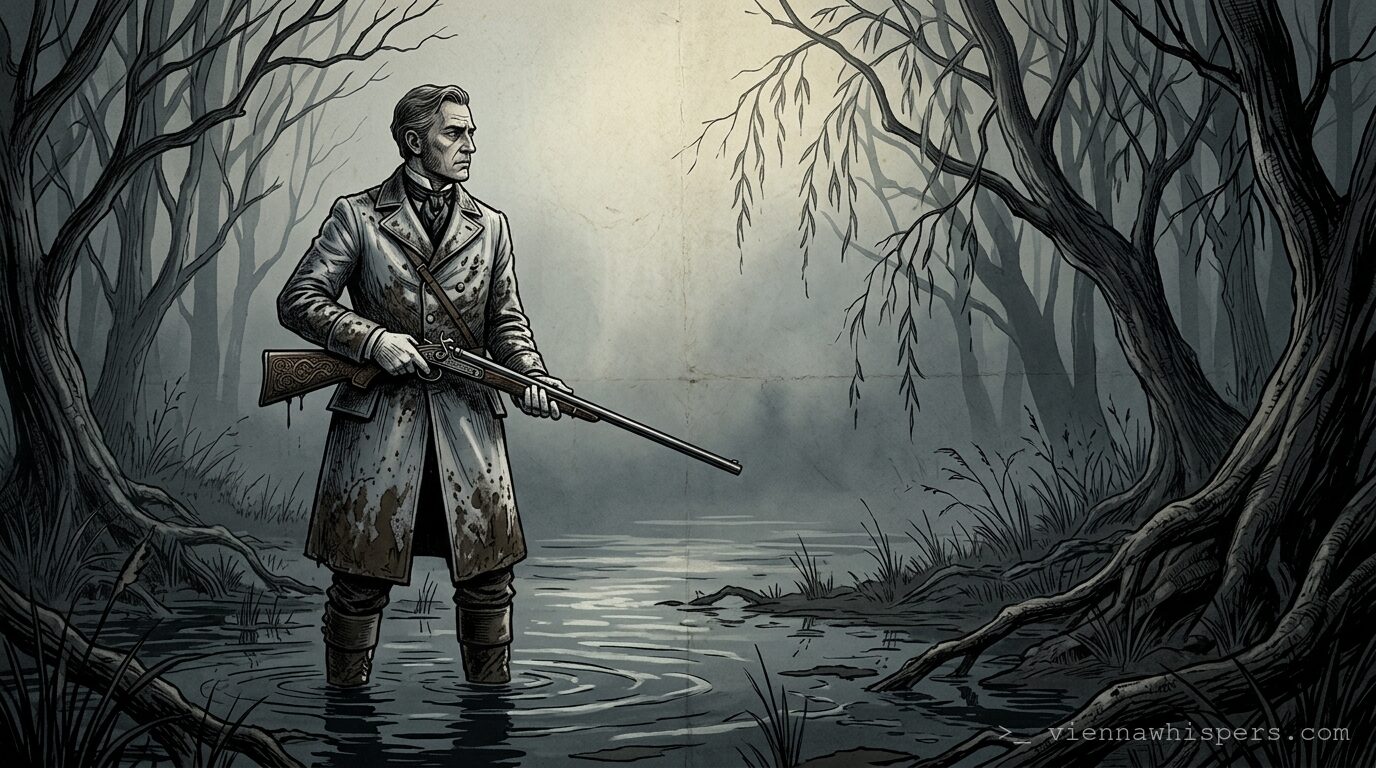
The Hunt That Never Ended
Count Ignaz von Rittenau stepped off the designated path not out of bravery, but out of petty irritation.
The year was 1784, and the Emperor’s hunting party was moving through the Prater Auen with the subtle grace of a marching artillery regiment. The dogs were hysterical, the beaters were shouting in crude dialect, and Rittenau’s position in the imperial retinue was humiliatingly far back—thirty paces behind a newly titled Bohemian glass merchant. It was a slight he felt physically, a tightening in his chest beneath the silver-threaded wool of his hunting coat.
When a massive fourteen-point stag broke the line and vanished into the dense, fog-choked undergrowth to the left, Rittenau saw his chance. He would drag the beast back by its antlers and drop it at the Emperor’s feet. He turned his horse, but the gelding refused the thicket, planting its hooves and shivering. Disgusted, Rittenau dismounted, tied the reins to a birch, and pushed into the wet green dark on foot.
He possessed the specific, brittle courage of a man who had never been told he was entirely irrelevant to the world.
The Prater Auen in November is a lung. It breathes water and rot. Long before the Danube was corseted into neat canals, it was a sprawling, chaotic delta of dead river arms, stagnant pools, and ancient oaks sinking slowly into black mud. The air here smelled of crushed fish, wet decay, and the deep, geological patience of silt.
Rittenau pushed aside a curtain of dead weeping willow branches. The mud immediately claimed the shine of his imported Spanish leather boots. He gripped his rifle—a beautiful, heavy thing inlaid with mother-of-pearl, inherited from a grandfather who had died at the siege of Belgrade. The weapon was a masterpiece of a dying century, carrying the quiet, obsolete gravity of an empire that still believed a crest on a piece of metal meant something to the dark.
He walked for ten minutes. The underbrush tore at his silk breeches. He stopped to listen for the dogs.
There was nothing.
The silence was not an absence of noise, but a heavy, deliberate pressure. The imperial hunting horns, which just moments ago had been deafeningly close, were gone. Not faded. Gone. It was as if someone had closed a thick velvet door between him and Vienna.
“Ferdinand!” Rittenau barked, calling for his servant.
The name left his mouth and simply dropped. The dense air refused to carry it. A quiet, dry laugh escaped his throat. It was an absurd situation. He was no more than four miles from the spire of Saint Stephen’s Cathedral. He could probably walk in a straight line and hit a coffeehouse. He adjusted his collar and checked his pocket watch. The gold casing was cool; the enamel face read three o’clock.
He began to walk back the way he had come. He walked for twenty minutes, his boots sinking deeper with every step. The birch tree where he had tied his horse was not there. Instead, there was a stagnant pool of black water. Sitting on the edge of the bank was a single, pale frog, the color of a boiled pearl, watching him with golden, unblinking eyes.
The geography was wrong. He knew the Prater. He had gambled away small fortunes in the pavilions near the main avenue. But this forest did not belong to the Enlightenment. The trees here were grotesquely thick, their bark slick with black moss, their roots twisting out of the water like the drowned arms of Ottoman soldiers.
The light began to fail. It did not dim gradually; it seeped away into the mud, as if the earth were drinking the sun.
Rittenau checked his watch again. Three o’clock. The hands had not moved. He tapped the glass, then wound the key. The spring snapped with a quiet, final ping inside the casing. He let the useless gold disc slide back into his waistcoat. The objects of his world were dying in his pockets.
A sudden, sharp panic touched the edge of his aristocratic brain, but he shoved it down with sheer, inherited arrogance. He was a Count of the Holy Roman Empire. Forests belonged to him, he did not belong to them.
He loaded his rifle. The powder felt slightly damp, but he rammed the ball down the barrel with furious, jerky motions. He would fire a shot. They would hear it. They would come.
He raised the beautiful, heavy gun toward the bruised purple sky and pulled the trigger.
The flint struck. A spark flared. The powder hissed—a weak, spitting sound—and then nothing. A misfire. The dampness had seeped into the pan. Rittenau stared at the weapon. It was no longer a firearm; it was merely a heavy, expensive stick of wood and iron.
The fog began to rise from the dead arms of the river. It moved thickly, rolling over the roots, smelling intensely of ancient ice.
Rittenau realized he was sweating despite the freezing air. His heavy silver-threaded coat felt like a leaden shroud pulling him down into the earth. Acting entirely against logic, and believing it to be a sound tactical decision, he unbuttoned the coat, peeled it off, and draped it carefully over the branches of a dead hawthorn bush. He smoothed the lapels. The silver embroidery caught the last, dying ambient light.
“I will return for it when the beaters arrive,” he said aloud. His voice sounded thin, like a beggar’s.
He walked on in his waistcoat and damp shirt, shivering violently, yet relieved to be rid of the weight. He was no longer walking toward Vienna. He did not know what he was walking toward. The forest had closed behind him, a slow-moving vault of timber and water.
It did not want to kill him. That would require malice, and the deep time of the Auen possessed no malice. It merely absorbed. It absorbed the Romans, it absorbed the plague dead, it absorbed the lost dogs, and it would absorb the minor nobility.
He reached a massive, fallen oak that bridged a stretch of bottomless black mud. His legs refused to carry him further. The chill had finally reached his bones, settling into the marrow with the comfortable finality of an old guest taking a familiar chair.
Rittenau sat down on the rotting bark. He crossed his legs, arranging his ruined silk breeches to preserve whatever dignity remained. He rested the useless rifle across his knees. He thumbed the hammer. The mother-of-pearl inlay felt exactly like a dead man’s teeth.
Support us
Vienna Whispers is free to read. If you enjoy the stories, we’d be grateful for your support.