I Have Always Been in the Third Act
Death did not make me profound. It merely made me perfectly punctual.
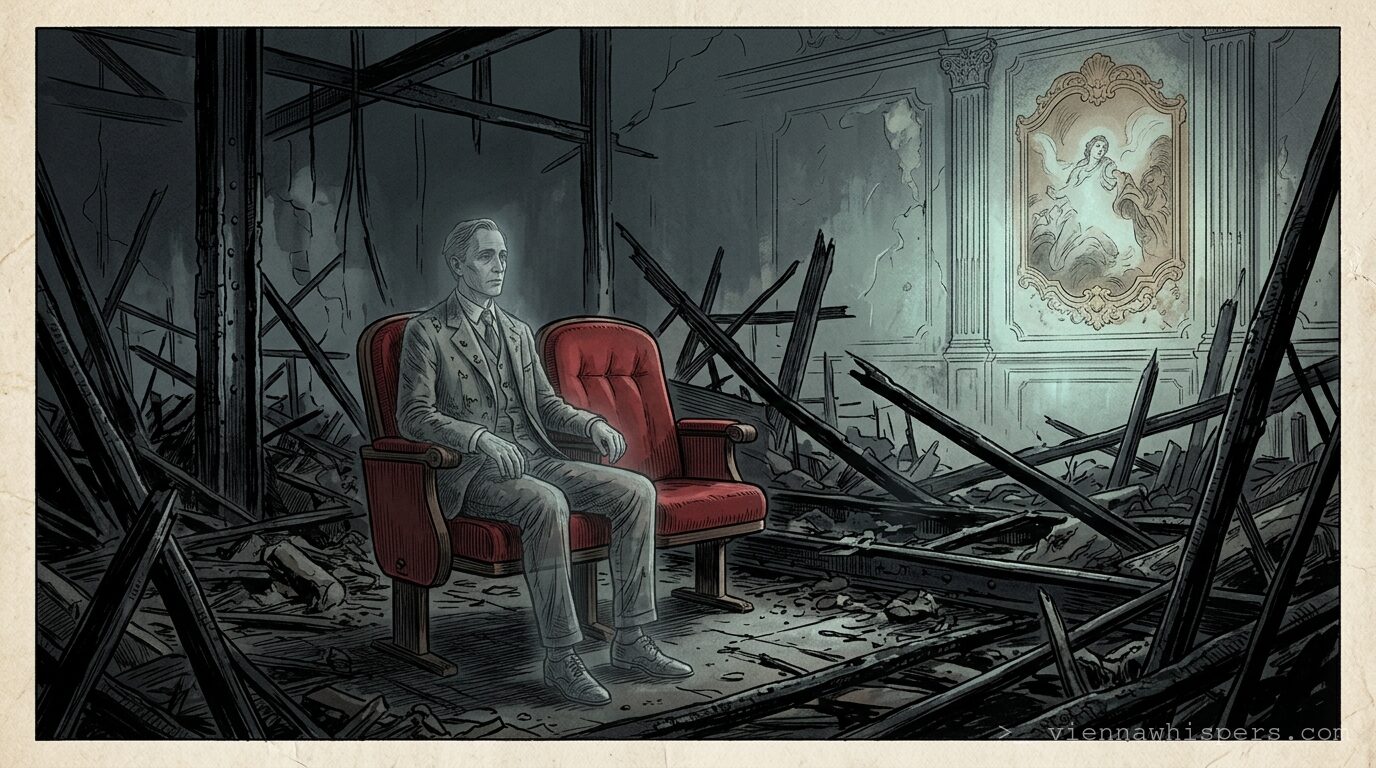
Since the fourteenth of October, 1888, I have been seated in the parquet of the Burgtheater. Row three, seat twelve. It is an excellent vantage point, slightly right of center, close enough to see the sweat pooling in the hollows of an actor’s throat, yet far enough back to appreciate the geometry of the lighting design. I am the ideal audience member. I do not cough. I do not unwrap peppermint candies during the quietest moments of a soliloquy. I do not fall asleep, though there were several productions in the 1970s that severely tested my endurance.
Living people overestimate the transformative power of dying. It strips you of your pulse, your legal standing, and your need for a winter coat, but it does absolutely nothing to cure your mediocrity. I was a junior clerk in the Ministry of Finance. My name was Johannes Falke. I spent my days verifying the taxation of imported Bohemian glass. I was not a romantic figure. I had a weak chin, a mild allergy to horse dander, and a habit of apologizing to furniture when I bumped into it.
I died on a Tuesday, three days after the Emperor officially opened the new theater building on the Ringstraße. I had purchased a ticket for a matinee. I was crossing the street, distracted by the glare of the new electric arc lamps—a brilliant, violent white light that seemed to erase the shadows of the Fiaker carriages. One of those carriages, drawn by a pair of startled greys, did not see me. A heavy iron-rimmed wheel crushed my chest against the wet cobblestones. It was a banal, bureaucratic sort of death. The police report likely noted that my pocket watch was smashed at precisely two-fourteen in the afternoon.
When I opened my eyes, I was here. In the dark. In row three.
I have watched them all. I watched the great tragic actors of the late nineteenth century, men with voices like brass horns who planted their feet and roared at the gaslights, their vowels rounded and heavy with Empire. I watched the hysterical, neurotic brilliance of the interwar years, when the air in the auditorium smelled of cheap tobacco and impending doom. I survived the bombing of April 1945. That was a magnificent, terrible piece of theater. The roof caught fire, the copper melting and dripping down like green tears. The stage collapsed into the cellars. I sat in seat twelve, suspended on a charred iron joist above a smoking crater, while the Klimt frescoes out in the grand staircases survived perfectly intact, mocking the ruins. I waited patiently through the ten years of reconstruction. When they finally rebuilt the auditorium and installed the new red velvet seats, I settled back in.
Now, the actors wear denim and spit their lines into microphones, pacing across stark, minimalist stages designed by young men who read too much French philosophy. It is exhausting, but I prefer it to the musicals.
They are, all of them, far more interesting than I ever was. They possess a vital, desperate vanity. They bleed for the attention of strangers. They memorize the agonies of kings and the betrayals of lovers, wearing these manufactured emotions like borrowed coats, hoping the fabric will hide their own small, human terrors. I envy them their terror. I envy their ability to fail so publicly.
I, on the other hand, am trapped in a perpetual state of observation. I am the gray shape in the peripheral vision of an aging understudy. I am the inexplicable cold draft that makes the heavy red velvet curtain shiver when the ventilation system is turned off. I am the reason dust motes, caught in the harsh beam of a profile spot, occasionally swirl and refuse to settle on the empty seat in the third row.
I have only one desire left, and it is entirely irrational. I wait for the performance where someone will look past the footlights, break the fragile membrane of the fiction, and say my real name.
Just once. I want to be recognized. I want to be part of the cast. I am tired of being an extra in the endless, repeating drama of Vienna’s cultural vanity. I want an actor, preferably one of the greats, to look at me and say, Johannes Falke. I do not need a monologue. A simple acknowledgement will do. A confirmation that my century and a half of perfect attendance has been noted.
It happened on a Thursday in late November. The air outside was thick with the smell of roasted chestnuts and damp asphalt. Inside, the heating system was humming, blowing dry, recycled air over the thousand empty seats. It was a dress rehearsal.
The play was a modern adaptation of something old and tragic—the director had cut half the text, dressed the cast in hospital gowns, and flooded the stage with harsh, clinical white light. The lead actor was a man named Moritz. Moritz was sixty-two, famously brilliant, famously difficult, and currently suffering through his third divorce. He had the heavy, ruined face of a man who drank expensive wine for breakfast to steady his hands.
It was the third act. It is always the third act where things fall apart.
Moritz was standing center stage, entirely alone. The lighting designer had isolated him in a tight, blinding pool of light. He was supposed to deliver a searing monologue about the impossibility of memory. It was the emotional anchor of the entire production.
He opened his mouth. Nothing came out.
I leaned forward in seat twelve.
There is a specific, suffocating silence that occurs when an actor dries up. It is not the respectful silence of an engaged audience. It is the panicked, sucking vacuum of reality breaking through the illusion. The oxygen leaves the room. The other actors in the wings hold their breath. The director, sitting a dozen rows behind me, stopped clicking his pen.
Moritz stared into the dark. His eyes were wide, glassy with sudden, terrifying emptiness. The lines were gone. Decades of technique, the muscle memory of a thousand performances, evaporated in a microsecond of biological misfiring. He was a naked man standing under a very bright light, entirely bereft of words.
From the hidden prompt box at the edge of the stage, a frantic whisper rose. The prompter, an invisible guardian angel of the theater, was desperately feeding him the first three words of the sentence.
Moritz did not hear her. Or if he did, his brain refused to process the sound.
His gaze drifted downward. It crossed the orchestra pit. It moved over the first two rows.
It locked perfectly onto seat twelve.
He was looking at me.
Living people rarely look at the dead. Even when they sense us, their minds instantly construct a rational alternative. A trick of the light. A reflection in a glass door. A sudden drop in blood pressure. But Moritz was stripped of his rationality by the sheer panic of the forgotten line. His mind was violently open, grasping for any anchor in the void.
He saw me. I know he did. He saw the gray, static outline of a clerk from 1888, sitting with his hands folded neatly in his lap, wearing a faint expression of polite expectation.
For the first time in one hundred and thirty-five years, I felt a physical sensation. It was a phantom tightening in my throat, the ghost of a heartbeat hammering against my ribs. I realized, with a shock of pure, unadulterated vanity, that I had power in this moment. The great Moritz was empty, and I could fill him.
I stood up.
I did not have vocal cords, but the dead can project intention. We can whisper directly into the subconscious. It is how we make you remember locked doors when you are already in bed, or how we force you to recall a humiliating failure from ten years ago while you are trying to enjoy a cup of coffee.
I locked my eyes onto Moritz’s ruined, sweating face. I reached across the dark, heavy air of the Burgtheater, past the dust and the history and the velvet, and I pushed the thought into his panicked mind.
Say it, I commanded. Say my name. Johannes Falke.
Moritz flinched. The muscles in his jaw worked. He was a vessel waiting to be filled, and I was pouring myself into him. He took a staggering half-step forward, right to the edge of the stage. The white spotlight followed him, casting a long, distorted shadow across the floorboards.
He opened his mouth. His lips parted.
“Johannes,” he whispered.
The sound carried perfectly through the immaculate acoustics of the auditorium. It was raspy, desperate, and deeply human.
I stopped breathing—a metaphorical reflex, but a profound one. He had said it. Johannes. I waited for the surname. I waited for the validation that would release me from the third row forever. The theater seemed to hold its breath with me. The director behind me did not speak. The prompter was silent.
Moritz blinked. The glassy panic in his eyes suddenly shattered, replaced by a strange, bewildered clarity. He blinked again, looking directly through me now, focusing on the heavy brass handles of the exit doors at the back of the hall.
He rubbed his face with a trembling hand and let out a short, harsh bark of a laugh.
“Johannes,” he said again, louder this time. He turned his head toward the dark wings. “Sorry. God, I’m sorry. My mind went entirely blank. I just kept thinking about my brother. Johannes.”
From the darkness of the stalls, the director groaned. It was the sound of a man who had lost all faith in art. “Your brother is an accountant in Salzburg, Moritz,” the director called out, his voice echoing with dry Viennese irritation. “Your character’s name is Arthur. The line is about Arthur. Shall we try it again from the entrance, or do you need to go call your accountant?”
“No, no. I have it,” Moritz muttered. He turned his back to me, rolling his shoulders, shaking off the tension. He stepped back into the exact center of the spotlight. He closed his eyes, inhaled deeply, and when he opened them, the ruin was gone. The character was back. The illusion had resealed itself.
I remained standing in the third row.
The moment had passed. I had suspended my own disbelief. I had believed, for ten seconds, that the theater’s magic could reach into the dark and pull me back into reality. But tragedy is merely a failure of timing; the rest is just lighting. He did not see me. He saw the void of his own memory, and his mind threw up the name of an accountant in Salzburg to fill the panic.
I was not a participant. I was merely a coincidence of nomenclature. Vienna does not reward sentimentality; it simply waits for you to realize your own irrelevance.
I sat back down. The red velvet of seat twelve accepted me without comment. I folded my hands in my lap. I watched Moritz take a breath, adjust his posture, and begin to speak of a memory he had never lived. I remained in the dark, watching the dust resettle where my heart used to be.
Support us
Vienna Whispers is free to read. If you enjoy the stories, we’d be grateful for your support.