Venice in Vienna, 1895
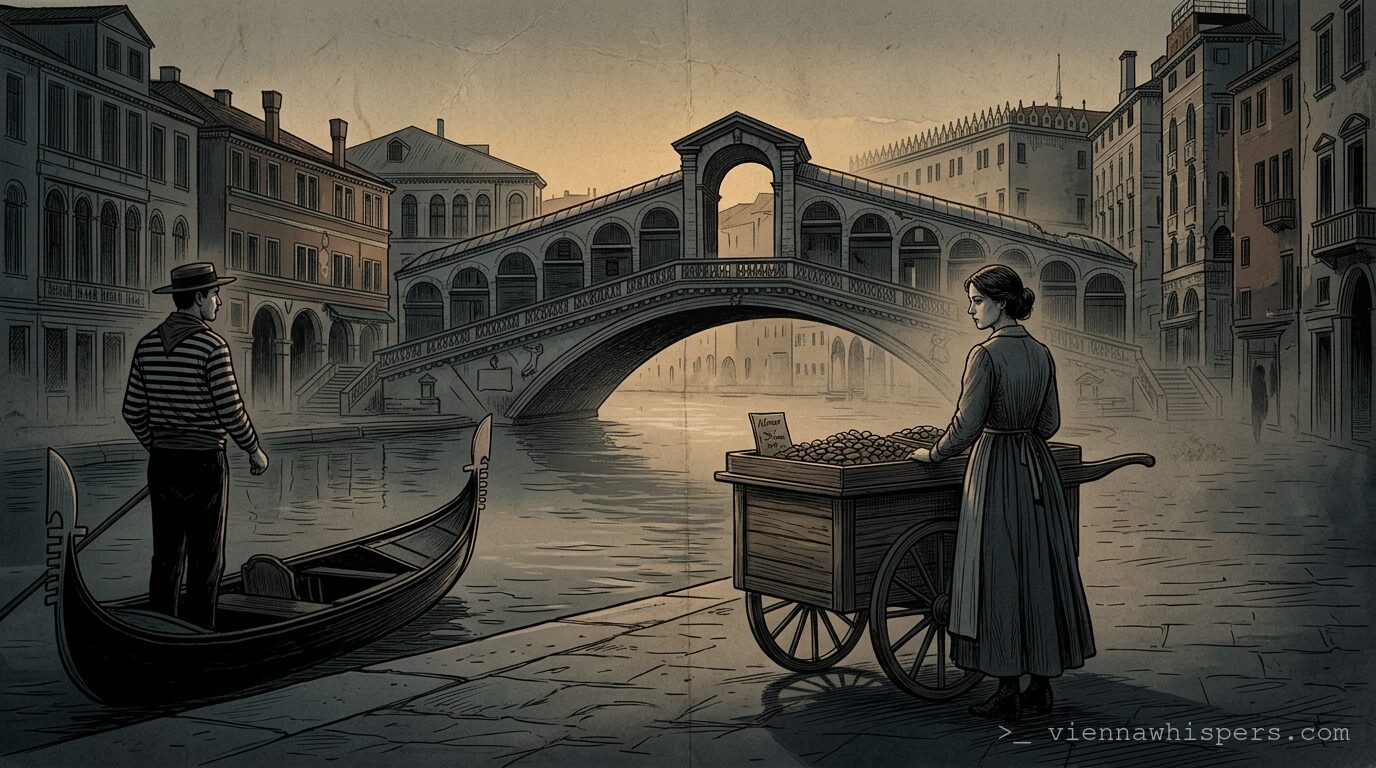
The water in the Prater’s Grand Canal was barely three feet deep, and by late August, it had developed the thick, unromantic scent of stagnant Danube seepage, spilled beer, and rotting lilac. Kathi did not mind. She stood behind her wooden cart near the canvas replica of the Bridge of Sighs, selling candied almonds in paper cones, and watched the sun turn the papier-mâché palaces into solid gold.
The real Vienna, waiting just beyond the turnstiles, was built of heavy, unforgiving stone. It smelled of horse dung, boiled cabbage, and class anxiety. It demanded obedience, taxes, and a lifetime of tired feet on cobblestones. Venedig in Wien was made of wooden lath, painted canvas, and plaster. It demanded only a fifty-kreuzer admission fee. Kathi, who rented a windowless room in Leopoldstadt that smelled permanently of other people’s damp wool, found this arrangement vastly superior.
Every evening at six, the Golden Hour hit the artificial facades. For about forty minutes, the illusion was flawless. The dust stirred by ten thousand promenading Viennese caught the low sunlight, acting as a soft-focus lens over the chipping paint of the Doge’s Palace. A hired orchestra played waltzes disguised as Italian folk songs. Waiters carried trays of local wine poured into imported glass.
Kathi watched a senior civil servant from the Ministry of Finance lean against a painted marble pillar. The man was exhausted, his posture ruined by decades of stamping documents for an empire that was slowly, politely dying. But here, leaning against a pillar that would collapse if he pushed it too hard, he looked entirely at peace. He understood this place. The Emperor’s realm was held together by red tape, titles, and habit; this Venice was held together by glue and canvas. The difference was merely one of duration.
“They’re saying it snows by November,” a voice said.
A gondola bumped against the wooden pilings near Kathi’s cart. The gondolier was a butcher’s son from Ottakring named Franz, though his nametag read Francesco. He wore a striped shirt and a straw hat, and when tourists dropped coins into the shallow water, he dropped his practiced Italian accent to curse in thick, gutteral Viennese.
“Then we will freeze,” Kathi said, handing a paper cone of almonds to a passing gentleman who didn’t look at her.
“My uncle has a room opening up in his building,” Franz said, leaning on his long oar. He looked at her with the dull, earnest affection of a man who intended to work forty hours a week until he died of a localized heart failure. “Real brick. Stove in the corner. You can’t stay in Leopoldstadt when winter hits.”
Kathi looked at Franz. He was offering her survival. He was offering her a solid life of scrubbing floors, boiling potatoes, and listening to him snore in a dark room. It was an incredibly kind offer. It made her stomach turn with absolute dread.
She looked away from him, toward the Rialto bridge. A piece of the plaster balustrade had broken off yesterday, revealing the cheap pine skeleton underneath. She felt a sudden, fierce rush of affection for that exposed wood. It was a relief to love something that made no promises of lasting. Real stone only ever locked you in.
“I like it here,” she said.
“Here is closing in three weeks, Kathi. They drain the water. They board up the cafes.” Franz sighed, his oar slipping on the muddy bottom with a hollow, pathetic splash. He lost his balance slightly, his arms windmilling before he caught himself. He swore loudly.
Kathi let out a quiet, uneven laugh. Not at the slapstick, but because his real, clumsy self had broken through the Venetian grace so easily. He looked annoyed, pushed off from the piling, and drifted away toward the fake lagoon.
She began to stay late. When the gas lamps were extinguished and the crowds filtered back out toward the Praterstern, the workers would sweep the alleys and the security guards would smoke by the exits. Kathi would wander.
In the blue, cooling twilight, the temporary city took on a strange, mythic gravity. Without the distraction of people, the silence in the artificial squares felt immense. She would run her fingers along the painted brickwork. She knew exactly where the canvas ended and the wooden scaffolding began. She knew that the statues of the saints were hollow inside. She preferred them hollow. When a drunk tourist had knocked over a cherub the week before, the head had snapped off and rolled into the canal with a hollow plop. Kathi had watched it sink, then gravely curtsied to the headless torso.
By mid-October, the frost arrived. The golden hour became thin and brittle. The leaves on the Prater trees turned yellow and began to drop, landing on the surface of the artificial canals like dead ships.
The crowds thinned. The admission price was halved, then halved again. The civil servants stopped coming.
On the final day, the sky over Vienna was the color of a bruised iron pot. Kathi sold her last cone of almonds at noon. At three o’clock, the pumps began to work. The management was draining the canals before the pipes could freeze.
She stood by the railing of the replica square and watched the water recede. It was a slow, unflattering process. The magic drained away, inch by inch, revealing the sloping concrete basin, thick with grey mud. The bottom of the Grand Canal was littered with the detritus of a dead season: dropped handkerchiefs, soggy admission tickets, a broken parasol, countless coins, and the bloated, papier-mâché head of the cherub.
Franz appeared beside her. He was wearing his winter coat over his striped shirt. He looked solid. He looked like the rest of her life.
“The cart is packed up,” he said softly. “I have a carriage waiting by the main gate. My uncle saved the room.”
Kathi looked at the damp, exposed foundation of the Doge’s Palace. The paint was peeling in long, sad strips, exposing the gray canvas beneath. It was the most ruined, pitiful thing she had ever seen. She loved it with a sudden, violent intensity. She did not want to survive the winter in a warm room in Ottakring. She wanted to remain here, in the cold, and rot quietly with the plaster.
“Go on, Franz,” she said. She did not turn to look at him.
“Kathi, there’s nothing left here.”
“I know.”
He stood there for a long time, the heavy reality of him pressing against the fragile air of the empty exhibition. Finally, she heard his boots crunch against the gravel, walking away, back toward the empire of stone and taxes.
Kathi waited until the sound of his footsteps disappeared entirely. She climbed over the low wooden railing and stepped down into the drained canal. Her boots sank immediately into the cold, heavy mud. She walked slowly toward the center of the basin, her skirts dragging through the silt, and bent down to pick up the ruined, waterlogged cherub head from the sludge.
Support us
Vienna Whispers is free to read. If you enjoy the stories, we’d be grateful for your support.