The Boy and the Statues
Mario’s mother worked the night desk at a mid-tier hotel on the Ring, leaving their apartment just off Praterstraße empty from nine until six. Summer in 2026 was suffocating. The asphalt sweated in the dark, and the heat hung over the Danube Canal like a wet towel. Mario, eleven years old and built like a fragile sparrow, carried a plastic SPAR bag of stolen kitchen scraps across the bridge into the Innere Stadt.
Half a stale Semmel. Three slices of Extrawurst, slick in their plastic wrap. A heel of dark bread.
Vienna crushes its children under the weight of its dead. There are too many emperors, too many muscular angels tumbling out of cornices, too many generals riding bronze horses into vanished wars. They demand reverence, and they take up all the air. Mario had discovered, quite by accident two weeks ago, that they were also starving.
He started at Michaelerplatz. The stone giants wrestling at the palace gates always looked exhausted to him, their massive thighs locked in eternal, pointless tension. Mario climbed the warm stone plinth, his sneakers making no sound, and pressed a rolled-up piece of sausage against the parted marble lips of a fallen titan.
The stone did not move, but the meat vanished. It simply folded into the dark slit of the mouth, accompanied by a sound like dry earth drinking rain.
Mario moved on to the minor niches. Saints with broken fingers, forgotten Habsburgs tucked into the soot-stained shadows of the Augustinerkirche. He fed them bread crusts. He fed them cubes of hard Emmentaler.
It was a transaction. As the stone grew sated, Mario grew translucent. His shorts now hung dangerously loose on his hips, and the dark circles under his eyes had deepened into permanent bruises. But the monuments were undeniably improving. The gaunt cheeks of a weeping cherub on the Graben had filled out with a faint, polished plumpness. The bronze horses seemed to stand straighter, their metal bellies thick with the dinners Mario denied himself. He didn’t mind. He liked having a secret routine that didn’t involve staring at the ceiling, waiting for morning.
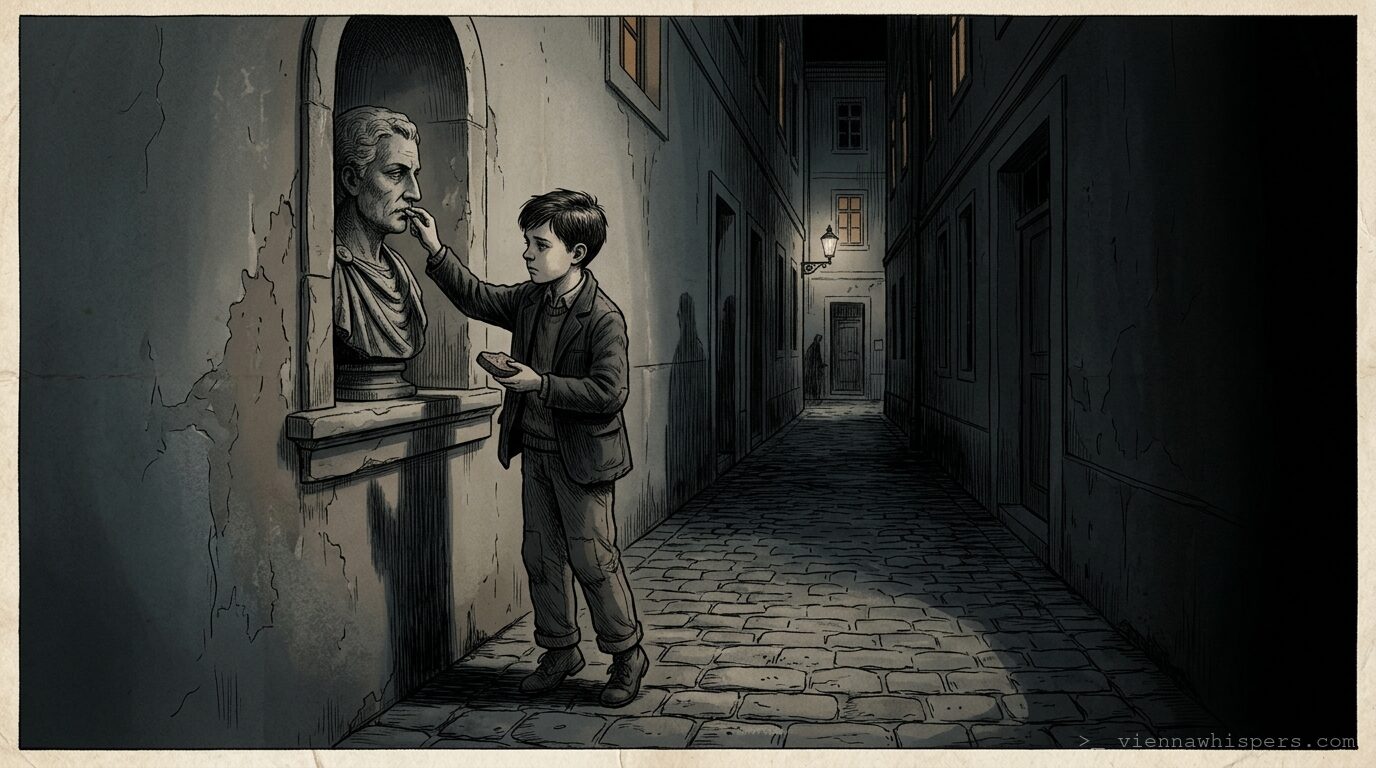
At two in the morning, he reached a blind alley near the Minoritenplatz. Here, a weathered stone bust of an unknown bureaucrat or minor lord sat low in a mossy alcove, largely hidden by a wrought-iron grate. Mario pulled out his last offering: a thick piece of leftover Schnitzel.
He reached through the bars. The stone lips were already parted in anticipation.
“A bit dry, Mario,” the statue said.
Mario froze, his thin wrist pressed against the cold iron. The voice did not echo. It was not the booming tenor of an ancient aristocrat. It was the nasal, slightly tired baritone of his father, who had gone out for cigarettes in the winter of 2023 and never returned to the 2nd District.
“You forgot the lemon,” the stone added. It carried a very slight Viennese drawl, laced with the exact petty dissatisfaction that used to fill their narrow kitchen.
Mario did not scream. He did not ask where his father had gone, or how a failed insurance salesman had ended up trapped in seventeenth-century limestone. Children understand early on that the city eventually consumes the people who cannot pay its tolls.
He simply broke off a smaller piece of the breaded meat, adjusting his grip so his bony fingers wouldn’t accidentally brush the teeth.
“I’ll bring lemon tomorrow,” Mario whispered.
He pressed the offering forward. A small piece of bread disappearing between cold marble lips under moonlight.
Support us
Vienna Whispers is free to read. If you enjoy the stories, we’d be grateful for your support.