The Red Currency
Anton’s hands were no longer his own; they belonged to the Wienerberg clay. He stood waist-deep in the pit, the cold, dense earth clinging to his skin like a second, grey-brown graft. At thirty, his fingers were permanently curved into the shape of a spade handle.
Above him, the sky over Vienna was a bruised purple. It was the Blue Hour, when exhaustion peaked and the air grew thick with coal smoke and the metallic tang of Blechmarken — the thin metal tokens that served as their only currency.
Across the yard, moving through the haze of the drying sheds, was Maria. She stacked the heavy, sodden bricks with a rhythm that defied the crushing weight of the day. Her palms were calloused into thick, yellowed pads, mapped with fissures that caught the grit of the clay.
When their eyes met, it was not romance. It was reconnaissance. They were checking if the other was still alive.
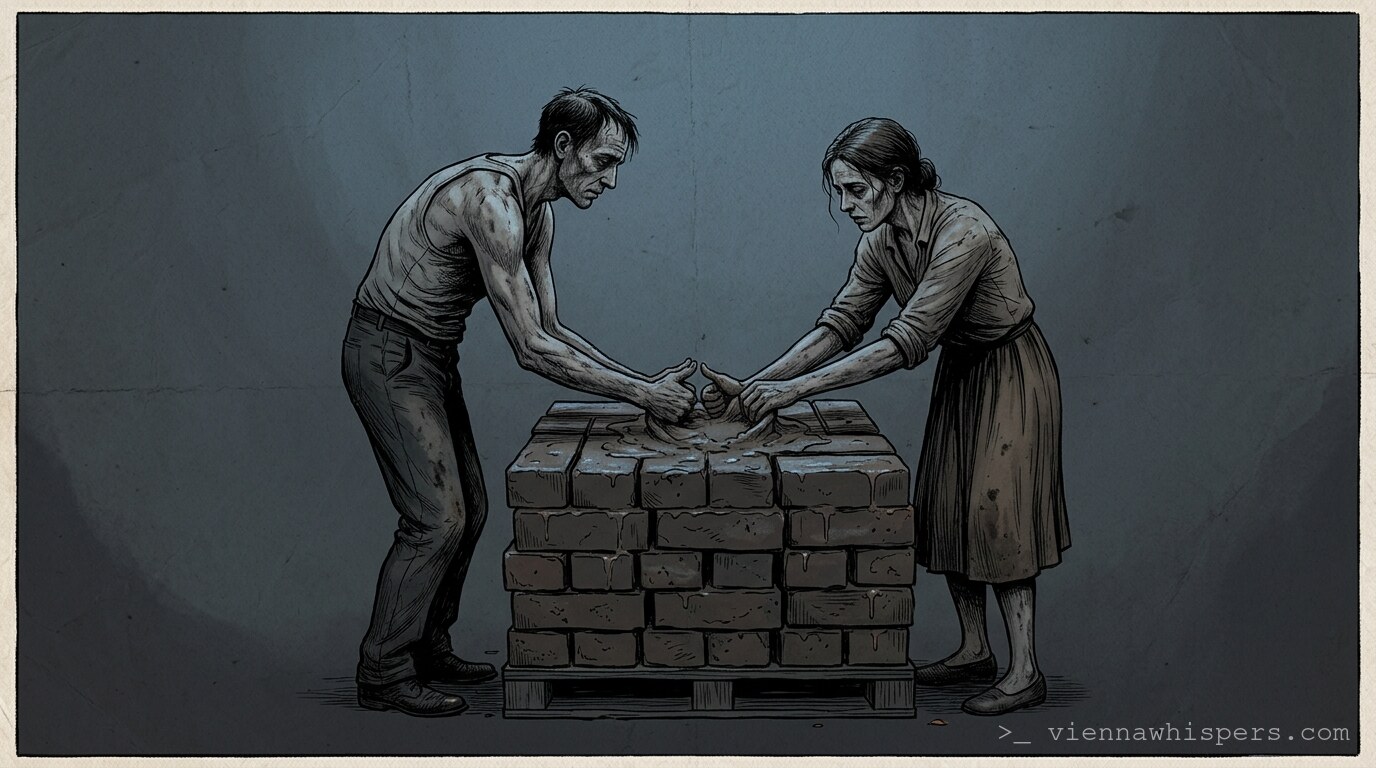
Maria reached the pallet Anton had just prepared. She leaned down, her fingers brushing the still-wet surface of a fresh brick. It was their secret, foolish liturgy. She pressed her right thumb into the soft mud, and Anton, leaning on his shovel, pressed his own thumb beside it.
The two indentations merged — a singular, mangled seal of their existence. It was the only thing they owned that the factory could not trade. They were married in the eyes of God, but owned by the kiln.
That night, in the cramped barracks they shared with two other families, Anton spilled their earnings onto the rough pine table. The Blechmarken clinked softly — thin, stamped discs of cheap metal that rattled like dry bones.
“Six tokens,” Maria whispered, her voice gravelly from dust. “Bread costs four. Lard is one.”
“And the wine?” Anton asked.
“We do not need the wine.”
He covered her hand with his. They counted the tokens again. Six for the week. They were young, hollowed out, and loved each other with the desperate intensity of two shipwrecked souls who knew the island was sinking.
Years later, the factory on the Wienerberg was gone, paved over by the progress of the Ringstraße.
In the late 1880s, a grand mansion stood near the Stadtpark, its façade a masterpiece of red-brick masonry. The merchant who built it wanted an aesthetic of strength. The masons laid the bricks with precision.
Deep within the structural core of the grand salon, shielded from chandeliers and polite laughter, lay a single brick. It was indistinguishable from its neighbors, save for a small, shallow depression on one face.
If one were to place a thumb into those marks, they would fit perfectly.
The house was always cold. The merchant’s wife often complained of a draft. She never knew she was leaning against a tombstone.
One evening, during a dinner party, the house settled. A low groan shivered through the walls. The guests didn’t notice, but the merchant paused, his silver fork hovering. For a fleeting second, he felt mud in his throat.
Outside, the wind whipped around the ornate corners, carrying the smell of rain. Below the floorboards, beneath the velvet rugs and gilded cornices, the city continued its slow, indifferent metabolism.
The brick held. It kept its seal. It remembered the smell of Anton’s sweat and the rhythm of Maria’s breath. It was the only currency that hadn’t been spent.
Support us
Vienna Whispers is free to read. If you enjoy the stories, we’d be grateful for your support.