The Elevator Operator in the Haas-Haus
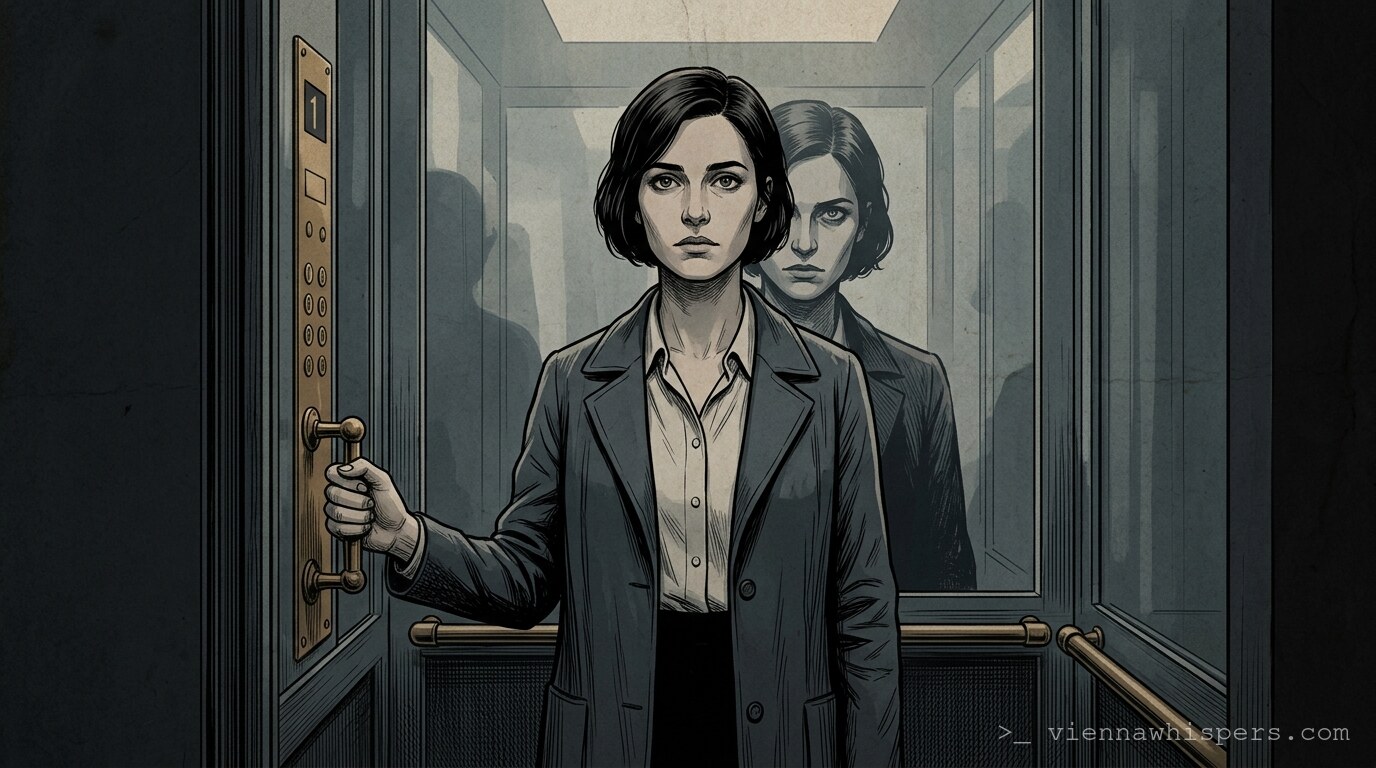
The brass lever is always cold, filmed with a faint metallic sweat that feels like a ghost’s palm. My name is Mira. I am twenty-six, and I am the only person in this glass-and-steel building who knows that the elevator has a pulse.
Hans Hollein built the Haas-Haus to argue with St. Stephen’s Cathedral across the square. A jagged mirror confronting Gothic stone. But the architects forgot about the shaft. Or perhaps they simply chose not to look too closely.
It is 2:14 a.m. The Stephansplatz is a void of damp cobblestones and indifferent statues. Inside the glass cage the light is a sickly gilded amber that makes my skin look like old paper. I push the lever forward. The elevator begins its ascent with a low, mechanical B-flat that vibrates through the soles of my shoes.
The buttons are suggestions. I have learned to read the machine’s moods by the way the floor numbers shudder as we pass them. Last Tuesday I held the lever between floors. The elevator tilted, a slow, nauseating lean, as if the entire building were adjusting its spine to better accommodate me.
Tonight the car is quiet. Too quiet. I stop at the fifth floor, but I do not open the doors. I keep the lever in the dead zone. The cables scream in a register only the house and I can hear.
In the mirrored wall I see myself at the lever. But behind my shoulder stands another Mira — uniform pristine, hair in a knot I stopped wearing three years ago. She is studying the back of my neck with clinical curiosity.
I do not turn around. Turning around would mean acknowledging that the space inside this elevator is no longer bound by normal geometry.
The lift shudders. A violent metallic clack runs down the shaft. Suddenly I am back at the ground floor, though I never moved the lever. The doors open.
A man is standing there. Heavy dark wool coat, briefcase humming with the same B-flat frequency as the cables. He steps in and stands far too close. His skin radiates no heat.
“Going up?” I ask.
“I am going home,” he replies.
We rise. As we pass the fourth floor the lights die. In the total darkness I hear hundreds of people whispering at once — every shopper, every thief, every lost soul who has ever leaned their forehead against this glass. The elevator is digesting its history, and it is hungry for a new entry.
My hand passes through the wall. It feels like plunging into cold running water. I pull back, gasping. The lights return.
The man is gone.
On the floor where he stood lies a small brass button — identical to the ones on my panel, but unmarked. It is warm.
I pick it up. For a fraction of a second I see the Haas-Haus from the outside, but it is not a building. It is a vast white ribcage arching over the city, and I am the small frantic thing trapped inside its chest.
I look at the button in my palm. It has no floor number. It is simply waiting.
I am twenty-six. I have a mother who worries, a cat that expects breakfast, and a lease due on the first. I stare at the button, my thumb hovering above it.
The elevator hums with desperate, metallic urgency.
I push the lever forward instead. I do not press the button. Not yet.
I look at the glass and see that the reflection of the building behind me is beginning to dissolve into stars — or into the hollow dark of a space where no one, not even the city, ever bothers to look.
I think I will stay here a while longer. The pay is terrible, but the company is becoming quite singular.
Support us
Vienna Whispers is free to read. If you enjoy the stories, we’d be grateful for your support.