The Thing That Waits in the U6 Tunnel
The U6 is not a subway. It is Vienna’s central nervous disorder, suspended on Otto Wagner’s elegant nineteenth-century arches, dragging itself north to south in a state of perpetual, vibrating exhaustion. It smells uniformly of wet wool, synthetic brake dust, and the stale grease of discount bakeries.
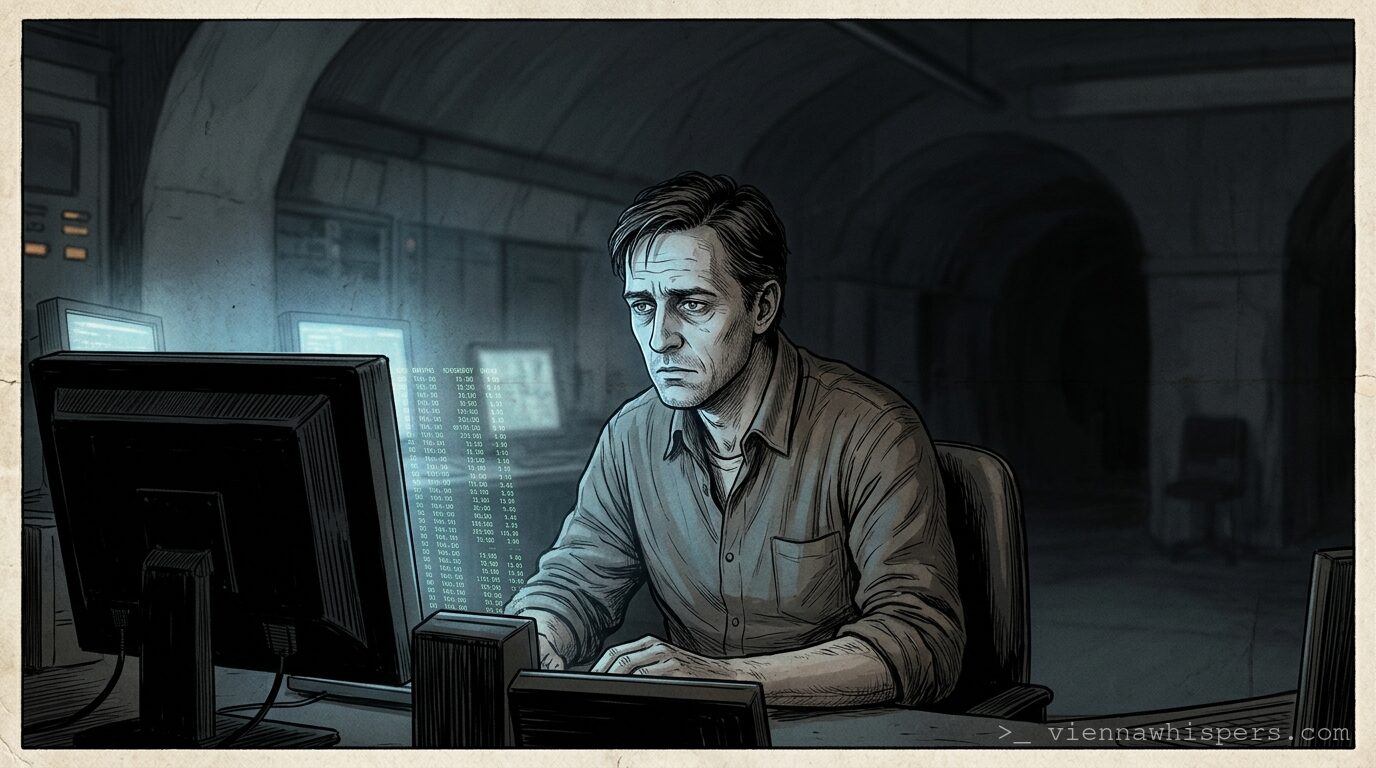
Thomas Fischer knew the line better than he knew the face of his ex-wife. He was a senior diagnostics technician for the Wiener Linien, a man who lived in the absolute, clinical certainty of numbers. He tracked wheel-slip ratios, voltage drops, and the microscopic wear of steel flanges. There is a specific comfort in knowing exactly how a heavy machine will fail, because it spares you the humiliation of hoping it won’t.
For eleven years, Fischer had monitored the telemetry from the subterranean command center in Erdberg. He was paid to find anomalies. Last Tuesday, at three in the morning, he found an absence.
It existed between the stations of Alser Straße and Michelbeuern-AKH.
The geography of this section is straightforward. The track leaves the historic brick arches, dips into a short, dark concrete throat, and emerges under the brutalist, looming shadow of the General Hospital. The distance between the platforms is exactly 482 meters. An articulated T-series train, traveling at its automated speed of 50 kilometers per hour, should traverse this dark throat in exactly 34.7 seconds.
According to the raw wheel-rotation sensors, every train took 51 seconds.
At first, Fischer assumed it was a calibration error in the relays. But he checked the power draw. He checked the signal blocks. The trains were not slowing down. The drivers were not braking. The trains simply entered the dark between Alser Straße and the hospital, and for 16.3 seconds, they ceased to accumulate distance.
Fischer ran the historical logs. The Wiener Linien had digitized their archives back to 1989, the year the old Stadtbahn was formally converted into the U6. He sat in the blue light of his monitors, drinking tepid coffee, tracking the gap backward in time.
In 2015, the discrepancy had been 11 seconds. In 2002, seven seconds. In 1989, it was a mere 2.1 seconds.
The gap was growing.
The dispatch software, designed by sensible engineers in Munich who abhorred a vacuum, had simply been autocorrecting the delay. It smoothed over the localized tear in reality to keep the performance indicators green. The software told the station displays that the train was arriving. It told the network managers that all was well. It was a perfectly Viennese solution: if an uncomfortable truth cannot be fixed, simply arrange the paperwork to hide it.
Fischer did not report the anomaly. A younger man might have. But Fischer was fifty-two, and he had recently begun to find the relentless, ticking progression of his own life unbearable. The idea of a place where time stumbled, where 16 seconds simply slipped off the official record, did not frighten him. It provoked a sharp, uncomfortable desire.
He wanted to know what those 16 seconds felt like.
Two nights later, during the maintenance window between 01:30 and 04:00 AM, Fischer parked his service van near the Gürtel. He wore his high-visibility jacket, a heavy hardhat, and carried a standardized halogen track-lamp. He descended the maintenance stairs at Alser Straße and began to walk north along the ballast stones.
The tunnel was damp, echoing with the low hum of the city above. Concrete dust coated his boots.
At 210 meters in, the air changed.
It was not a sudden drop in temperature. It was a shift in density. The ambient noise of the city—the distant sirens on the ring road, the dull vibration of the hospital’s massive ventilation turbines—faded out. In its place came a heavy, insulated silence, layered with an impossible smell.
Fischer stopped. He raised his lamp. The beam of light seemed sluggish, struggling to push through the dark.
He smelled wood polish. Heated resistors. Ozone. The unmistakable, deeply ingrained odor of stale Milde Sorte cigarette smoke. It was the scent of the old brown-and-white E6 tram cars that had run on these tracks in the 1980s. A ghost smell, trapped in a pocket of space that the present tense had somehow failed to overwrite.
He looked down at the ballast. Between the sleepers, slightly trembling in the draft of his own breathing, lay an FFP2 mask. Half a meter away, completely untarnished, sat a silver ten-schilling coin minted in 1988. Both were coated in the exact same layer of undisturbed, synthetic brake dust.
Fischer felt the hairs on his arms rise, a slow, creeping dread that was entirely devoid of panic. It was the clinical terror of a man watching a mathematical proof dissolve. There was no monster in the U6 tunnel. There was simply a structural failure in the architecture of the hour. The gap was accumulating the discarded weight of the city’s past, holding it in a silent, expanding void beneath the hospital.
A rational man would have turned back. He would have filed a report about poor ventilation and requested a transfer to the U1 line. Fischer clicked his lamp off.
The darkness was absolute. It was thick and strangely soft.
He stood in the center of the tracks, closed his eyes, and pressed the button on his digital stopwatch. The numbers glowing in the dark read 00:00:00. He waited. He could feel the slow, heavy pressure of the 1980s pressing against his chest, the weight of unrecorded minutes piling up in the dark.
He did not want to leave. The city above was full of schedules, failing joints, and ex-wives who looked at him with tired pity. Here, in the uncalibrated dark, he did not have to arrive.
Fischer dropped the stopwatch onto the stones and listened to it hit the ground, noting with quiet satisfaction that the sound took just a fraction of a second too long to reach his ears.
Support us
Vienna Whispers is free to read. If you enjoy the stories, we’d be grateful for your support.